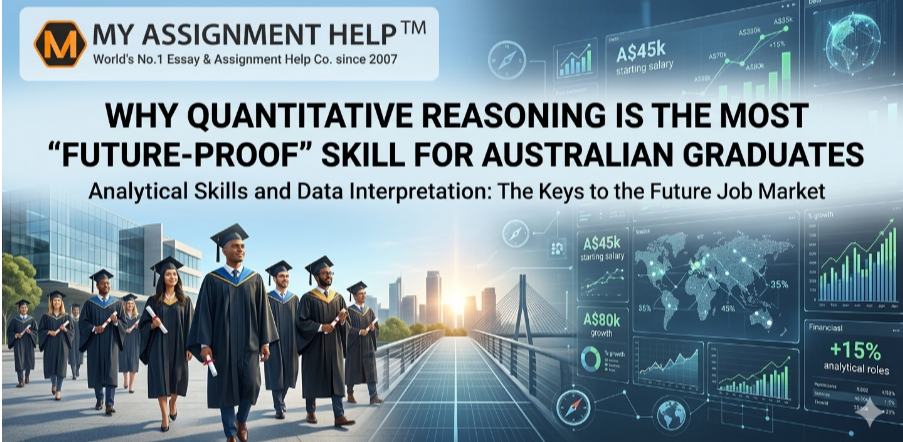
As the Australian economy pivots toward a digital-first, data-driven landscape, the definition of “employability” is undergoing a seismic shift. While technical proficiency in specific software may become obsolete within years, one fundamental cognitive ability remains consistently in high demand: Quantitative Reasoning (QR).
For university graduates in Sydney, Melbourne, Brisbane, and beyond, QR is no longer just a requirement for STEM majors; it is the ultimate survival tool for the modern professional world.
The Skill That Defines the Modern Australian Workforce
Quantitative reasoning is the ability to apply mathematical concepts to real-world contexts to make informed decisions. Whether it is a marketing manager analysing A/B test results or a policy analyst evaluating the impact of a new tax, the capacity to interpret data is paramount.
In fact, according to the National Skills Commission, occupations requiring high-level numeracy skills are projected to grow significantly faster than those that do not, making it a critical focus for those seeking myassignmenthelp in their academic journey. Students often find that mastering these concepts early, perhaps through specialized Algebra assignment help, provides a foundational logic that extends far beyond the classroom and into the boardroom.
The Australian Market: A Data-Driven Landscape
The Australian Bureau of Statistics (ABS) recently highlighted that over 80% of all new jobs created in Australia require some level of digital literacy, of which data interpretation is a core pillar. As industries like AgTech in Queensland and FinTech in NSW expand, the “soft” skill of understanding “hard” numbers has become a universal language.
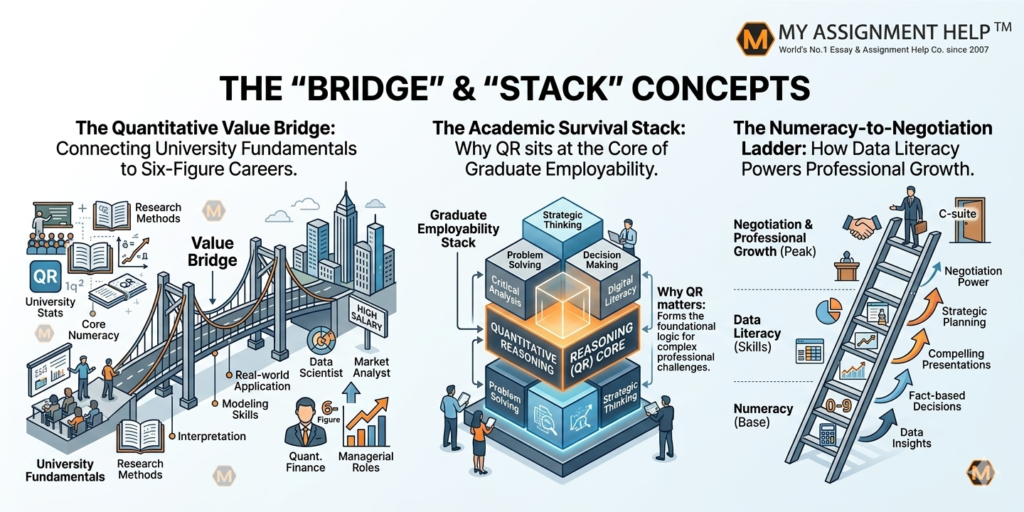
Graduates who can look at a spreadsheet and see a narrative, rather than just a grid of figures, possess a competitive edge that AI cannot easily replicate. The “future-proof” nature of QR lies in its versatility. While a specific programming language might fall out of favour, the logic required to structure a quantitative argument is eternal. This is why many students reach out and say, “help me with my assignment” when they encounter complex statistical modules; they recognize that these hurdles are actually the building blocks of their future careers.
Beyond Arithmetic: The Critical Thinking Element
It is a common misconception that quantitative reasoning is simply “being good at maths.” In reality, it is a form of critical thinking. It involves:
- Data Literacy: Dissecting statistics to find the truth behind the headline.
- Risk Assessment: Using probability to forecast potential outcomes in business or science.
- Pattern Recognition: Identifying trends before they become obvious to the general market.
Addressing the “Maths Anxiety” Gap
Despite its importance, “maths anxiety” remains a significant barrier for many Australian students. A report from the Australian Mathematical Sciences Institute (AMSI) noted a decline in advanced maths participation in secondary schools.
This gap creates a massive opportunity for graduates who do invest in their numerical fluency. By overcoming these hurdles—often with the support of academic mentors—students position themselves in the top tier of the candidate pool. When you can back your professional claims with verified data, you move from being a “candidate” to a “consultant.”
Key Takeaways for Graduates
- QR is Universal: It applies to Creative Arts, Humanities, and Science alike.
- Higher Earning Potential: Data-competent roles in Australia consistently offer higher entry-level packages.
- AI Synergy: QR allows you to work with AI by verifying and interpreting its outputs.
- Problem Solving: It provides a structured framework to solve complex, non-linear problems.
Conclusion: Investing in Your Future
For the Australian graduate of 2026 and beyond, the message is clear: numbers are the new literacy. By fostering a mindset that embraces quantitative evidence, you aren’t just passing a unit; you are securing your place in an unpredictable global economy. Whether you are navigating the complexities of financial models or simply trying to understand market trends, your ability to reason with numbers will be your greatest asset.
FAQ Section
Q: Is quantitative reasoning only for STEM students?
A: Absolutely not. HR, marketing, and legal professionals all use QR to analyze performance metrics, budget forecasts, and evidence-based trends.
Q: How can I improve my QR skills if I’m not “a maths person”?
A: Focus on real-world application. Try interpreting news statistics, playing logic-based games, or taking introductory data courses that emphasize logic over pure calculation.
Q: Why is QR considered “future-proof”?
A: Unlike specific software skills, QR is a foundational logic. As long as humans (and AI) use data to make decisions, the ability to interpret that data will be essential.
Author Bio
James Robertson is a Senior Academic Consultant at myassignmenthelp with over a decade of experience in the Australian higher education sector. Specializing in curriculum alignment and strategic academic support, James is passionate about bridging the gap between university learning and the evolving requirements of the modern workforce.
References:
- Australian Bureau of Statistics (ABS) – Labor Force Trends 2025-26
- National Skills Commission – State of Australia’s Skills Report
- Australian Mathematical Sciences Institute (AMSI) – Participation Reports